In today’s fast-moving retail and e-commerce environment, warehouse automation is no longer just a technology upgrade; it is becoming a strategic necessity. Asia-Pacific is also identified as the fastest-growing market, supported by e-commerce expansion and growing demand for faster fulfillment. Consumers expect faster delivery, higher order accuracy and a seamless shopping experience across online and offline channels.
Global e-commerce sales are forecast to reach US$6.88 trillion in 2026, representing 21.1% of total retail sales. In China, online retail sales reached RMB 15.97 trillion in 2025, up 8.6% year-on-year, with online retail sales of physical goods accounting for 26.1% of total retail sales of consumer goods. These trends are reshaping warehouse operations, especially for retail, apparel and footwear brands managing large SKU volumes, promotional peaks and increasingly complex B2B and B2C fulfillment requirements.
What challenge does warehouse automation address?
E-commerce growth has changed the role of the warehouse. Traditional operations were often designed around bulk movement, store replenishment and predictable order cycles. Today, many brands need to manage store distribution, online orders, campaign peaks, product launches and reverse logistics within the same network.
This creates higher operational complexity, including smaller order quantities, higher order frequency, greater SKU variation, tighter dispatch timelines and more frequent returns. Without the right automation and warehouse management capabilities, maintaining speed, accuracy and cost efficiency becomes increasingly challenging as order volumes grow.
Why is automation becoming more important?
Warehouse automation is increasingly seen as a practical response to rising fulfillment complexity. The global warehouse automation market is expected to grow from US$34.17 billion in 2026 to US$65.74 billion by 2031, at a 13.98% CAGR. In China, the market is estimated at around US$4.7 billion, driven by e-commerce growth, rising labor costs and the adoption of AGVs, AI, robotics and warehouse management systems.
Automation is no longer only about reducing manual work. It is about creating more intelligent, flexible and data-driven fulfillment operations that improve processing speed, reduce errors, increase storage efficiency and strengthen visibility across inbound, storage, picking, packing and outbound activities.
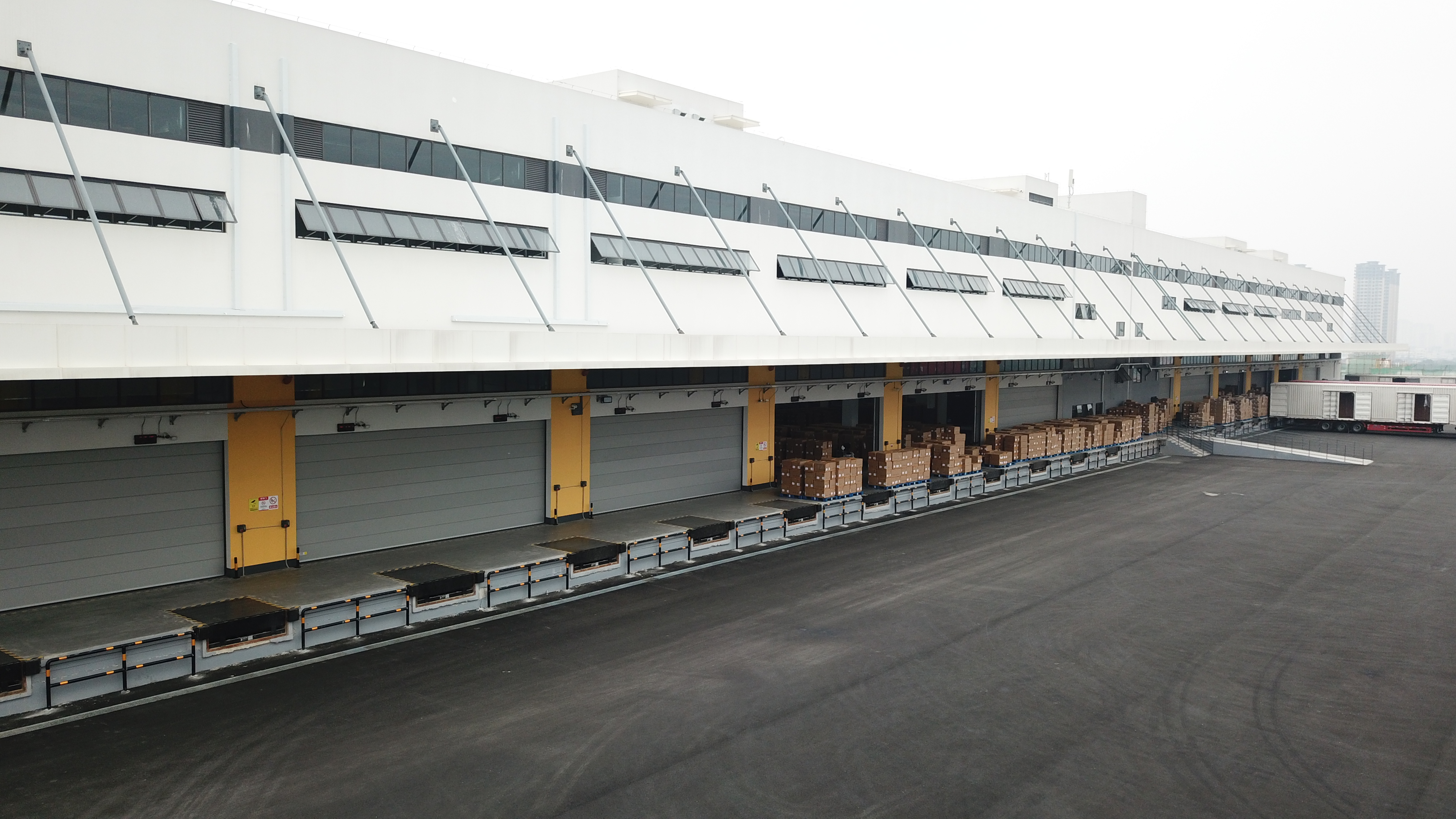
Cargo loading and unloading at open warehouse loading docks
How did OOCL Logistics support the customer?
OOCL Logistics recently launched a fully automated warehouse operation in Nanning, China, supporting one of China’s leading sportswear brands. Spanning approximately 100,000 square meters, the facility supports both B2B warehouse operations and B2C e-commerce fulfillment, with around 50,000 square meters dedicated to each segment.
The facility integrates four-way shuttle pallet storage, CTU bin storage, AGV goods-to-person picking systems and automated sorters to improve storage, picking, and sorting and dispatch efficiency. It is also supported by system-driven scheduling and inventory visibility from order receipt to final dispatch, allowing the warehouse team to monitor progress, manage inventory and respond faster to operational changes.
After initially supporting B2B footwear and apparel distribution across multiple provinces in China, the facility expanded into B2C e-commerce fulfillment. Within a short ramp-up period, B2C order handling scaled from approximately 6,000 orders per day to around 61,000 orders per day, exceeding the customer’s forecast by 10%. During the peak period, the team achieved 100% compliance with the 24-hour gate-out KPI, supported by effective workforce coordination, automation-enabled workflows and strong on-site execution.
What made this project effective?
The success of this project was not only driven by automation technology. It was also built on OOCL Logistics’ operational experience in footwear and apparel logistics, including warehouse layout planning, equipment coordination, process design, labor management, system integration and exception handling.
The project demonstrates that automation works best when implemented as part of an end-to-end logistics solution. As retail and e-commerce supply chains continue to evolve, scalable warehouse automation will be key to helping brands respond faster, operate smarter and deliver more consistent customer experiences.
Automated operations area with conveyors, robotic arms, and Automated Guided Vehicles (AGVs)
References
1. EMARKETER. (2026). Ecommerce sales: Reports, statistics and marketing trends.
https://www.emarketer.com/topics/industry/ecommerce-sales
2. Mordor Intelligence. (2026). Asia-Pacific warehouse automation market size and share analysis: Growth trends and forecasts, 2026–2031.
https://www.mordorintelligence.com/industry-reports/asia-pacific-warehouse-automation-market
3. Mordor Intelligence. (2026). Warehouse automation market size and share analysis: Growth trends and forecasts, 2026–2031.
https://www.mordorintelligence.com/industry-reports/warehouse-automation-market
4. National Bureau of Statistics of China. (2026, January 20). Total retail sales of consumer goods in December 2025.
https://www.stats.gov.cn/english/PressRelease/202601/t20260120_1962354.html
5. OOCL Logistics. (2026). Nanning automated fulfillment project: Internal operational performance data. Internal company records.
